
Try your first query #
Starburst Galaxy’s convenient query editor allows you to author queries using SQL.
Access the query editor from the Query section of the navigation menu, and query our built-in sample datasets.
Try a simple query #
Here is an example of a simple query you can try:
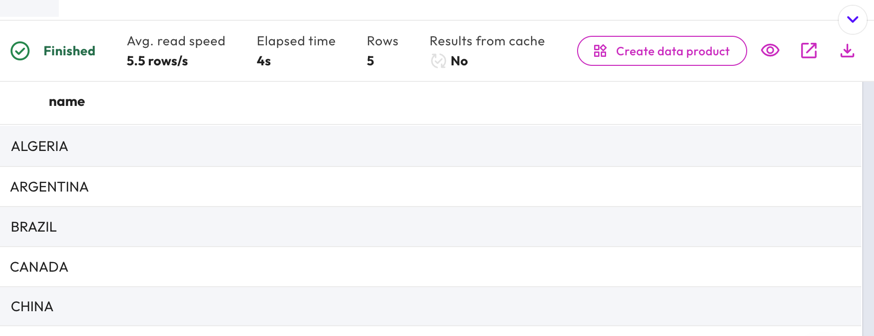
SELECT name FROM tpch.tiny.nation ORDER BY name LIMIT 5;
The result set:
Try a complex query #
The query editor comes with sample data and built-in queries that let you perform query federation.
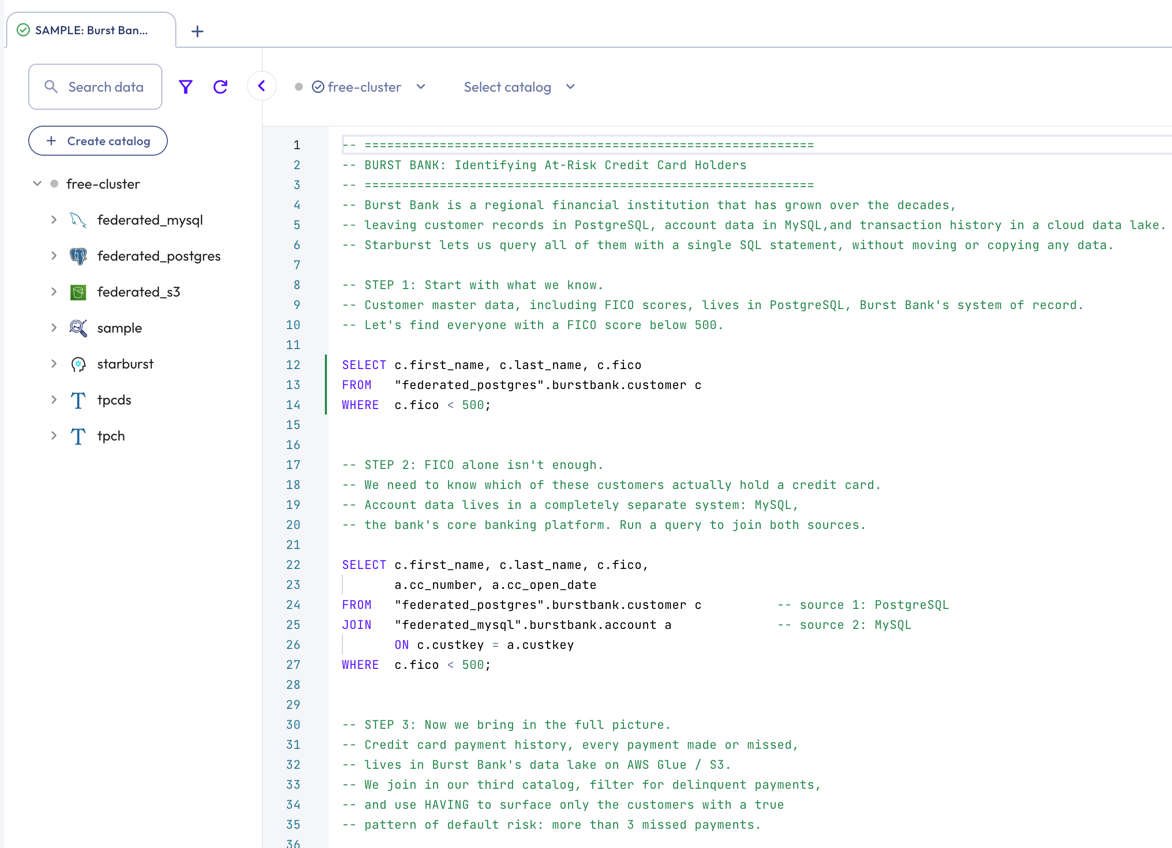
These queries analyze Burst Bank’s customer base and identify at-risk credit card holders across multiple data sources. Here is a preview of what you can expect to see in Galaxy:
1. Customer master data is stored in PostgreSQL, Burst Bank’s record system. Run the following query to find customers with a FICO score below 500:
SELECT c.first_name, c.last_name, c.fico
FROM   federated_postgres.burstbank.customer c
WHERE  c.fico < 500;
2. Burst Bank’s record system is stored in PostgreSQL, while account data resides in MySQL. Run the following query to join the sources and find customers with credit scores below 500 who also hold a credit card:
SELECT c.first_name, c.last_name, c.fico,
       a.cc_number, a.cc_open_date
FROM   federated_postgres.burstbank.customer c
-- source 1: PostgreSQL
JOIN   federated_mysql.burstbank.account a
-- source 2: MySQL
       ON c.custkey = a.custkey
WHERE  c.fico < 500;
3. Credit card payment history, including all payments, is stored in Burst
Bank’s data lake on Amazon S3. Run the following query to join in a third
catalog and filter for delinquent payments. Use the HAVING clause to find
customers with more than three missed payments:
SELECT c.first_name, c.last_name, c.fico,
       a.cc_number, a.cc_open_date,
       count(cp.delinquent_payment) AS num_delinquent_payments
FROM   federated_postgres.burstbank.customer c
-- source 1: PostgreSQL (customer master / FICO)
JOIN   federated_mysql.burstbank.account a
-- source 2: MySQL (accounts / credit cards)
       ON c.custkey = a.custkey
JOIN   federated_s3.burstbank.credit_card_payment cp
-- source 3: AWS (payment transaction history)
       ON cp.cc_number = a.cc_number
WHERE  cp.delinquent_payment = 'Y'
  AND  c.fico < 500
GROUP BY a.cc_number, c.first_name, c.last_name,
         a.cc_open_date, c.fico
HAVING count(cp.delinquent_payment) > 3;
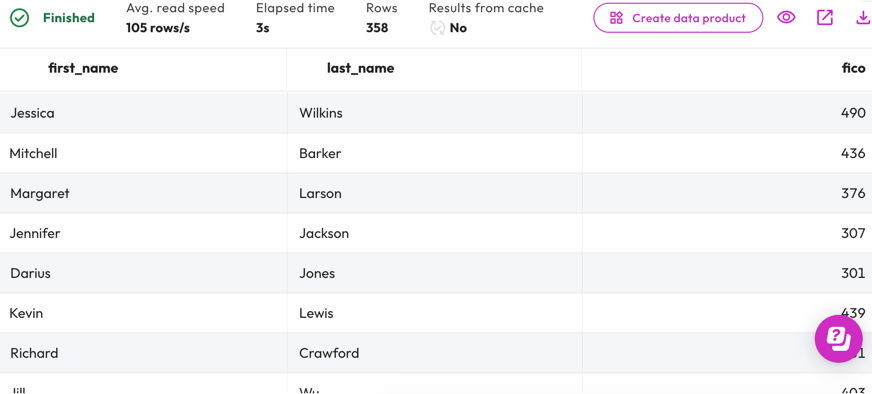
The result set of at-risk credit card holders:
Galaxy supports access to object-based storage, relational, and non-relational database management systems. When you are ready, you can query data from your own data sources.
Next steps #
- Learn how to create an object storage catalog.
- Learn about Starburst Galaxy’s available catalogs.
- Connect Galaxy to Tableau and build your first dashboard.
- To get help, chat directly with Galaxy support staff as described in Help center.
Is the information on this page helpful?
Yes
No